 acadewise
In this blog, we’ll compare Seedream vs Nano Banana, two of the most powerful AI tools of 2025. This Seedream vs Nano Banana comparison explores their features, performance, pricing, and which is the best AI software 2025.
In 2025 the AI image-generation race heats up. Google DeepMind’s latest model, officially Gemini 2.5 Flash Image (nicknamed “Nano Banana”), debuted in August 2025 and quickly went viral for its advanced editingen.wikipedia.orgwired.com. Shortly after, ByteDance (TikTok’s owner) launched Seedream 4.0 – a unified image generation and editing AIseed.bytedance.comscmp.com. Seedream 4.0 aims to “surpass” Nano Banana on key benchmarksscmp.com. Both tools represent cutting-edge AI of 2025, but the real battle is Seedream vs Nano Banana for the best image creation and editing. In this Seedream vs Nano Banana comparison, we’ll cover their features, performance, use cases, UX, pricing, pros/cons, and finally decide which is the best AI software of 2025 for different users.
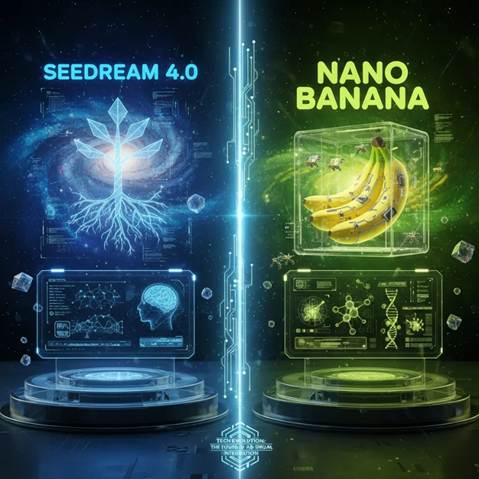
Figure 1: Seedream 4.0 vs Nano Banana AI futuristic comparison – advanced AI innovation, neural networks, biotechnology, and next-gen artificial intelligence tools.
Seedream vs Nano Banana: Core Features Compared
This Seedream vs Nano Banana comparison highlights their unified editing and high-resolution generation. When comparing Seedream vs Nano Banana, both next-gen AI tools stand out for unified generation and editing. However, Seedream 4.0 focuses on ultra-fast 4K batch generation, while Nano Banana (Gemini 2.5) excels at intuitive photo edits with strong subject consistency. This Seedream vs Nano Banana comparison shows how ByteDance and Google are competing for the title of the best AI software 2025.
- Unified Generation & Editing: Both models combine text-to-image generation and image editing. Seedream 4.0 “integrates image generation and image editing into a single, unified architecture,” handling complex tasks with reference consistencyseed.bytedance.com. Nano Banana likewise lets users start with a photo and apply sophisticated edits via text promptsblog.google. For example, you can tell Seedream “remove the person” or Nano Banana “change the outfit,” and the AI will precisely alter the image.
- High Resolution & Batch Output: Seedream 4.0 produces high-definition images (up to 4K resolution) at very fast speedsseed.bytedance.comflux1.ai. It can also generate multiple images in one go (up to 9 matching outputs simultaneously)flux1.ai. Nano Banana’s Gemini model similarly supports high-res outputs for detailed scenes, and it can blend multiple input images or batch edits (e.g. combining photos)gemini.googlegemini.google. Both tools excel at creating consistent multi-image results across a series (such as product shots or storyboards).
- Advanced Editing Tools: Seedream 4.0 offers comprehensive editing features – inpainting/outpainting, background swaps, object insertion/removal, style transformations, color/lighting adjustments, etc.flux1.ai. It excels at fine-grained changes while keeping the rest of the image intact. Nano Banana’s standout editing includes changing hairstyles/outfits, relocating objects, blending photos together, and applying one image’s style onto anotherblog.googlegemini.google. Notably, Nano Banana “maintains a consistent likeness” when you change a person’s look (e.g. new costume or pet)blog.googleblog.google. Both models support iterative edits – you can refine the image in multiple steps with new prompts.
- Multi-Image & Style Guidance: Users can guide both models with reference images. Seedream 4.0 lets you upload up to 10 images and blend them into one result, or consistently apply styles from examplesseed.bytedance.comanalyticsvidhya.com. Similarly, Nano Banana allows photo fusion – upload multiple photos to merge scenes (e.g. combine a person with a background)gemini.googlegemini.google. Both support “subject consistency,” meaning the same person or object keeps its identity across editsseed.bytedance.comblog.google.
- Text & Language Support: A key Seedream 4.0 feature is superior text rendering in images. It reliably reproduces precise multilingual text (English, Chinese, Japanese, Spanish, etc.) within generated picturespollo.ai. Google’s Gemini engine has also improved typography: Nano Banana “renders text with a new level of accuracy” in imagesgemini.google. This makes both tools suitable for creating ads, posters, or diagrams that include readable labels or logos.
- Advanced AI Capabilities: Behind the scenes, both use world-knowledge and reasoning to enhance results. For instance, Seedream’s “knowledge-driven generation” can produce charts, diagrams, and educational illustrations accuratelyseed.bytedance.com. Nano Banana integrates world context too (e.g. knowing how objects relate in a scene)blog.google. Additionally, Nano Banana embeds a SynthID watermark in its outputs (an invisible signature to identify AI-generated content)en.wikipedia.org, helping trace AI media.

Figure 2:Sample output from Seedream 4.0 – a photorealistic portrait created from a text prompt seed.bytedance.com.
| Attribute | Seedream 4.0 | Nano Banana (Gemini 2.5) |
| Output Resolution | Up to 4K (HD image generation)seed.bytedance.com | Up to 4K |
| Generation Speed | Ultra-fast (~1.8s for a 2K image)flux1.ai | Fast (typically a few seconds per image) |
| Batch Generation | Up to 9 images at onceflux1.ai | Multi-image editing (combine multiple inputs)gemini.google |
| Editing Capabilities | Rich editing: background swap, remove/add objects, style transforms, etc.flux1.ai | Rich editing: outfit/hair changes, style transfer, iterative editsblog.google |
| Subject Consistency | Yes – maintains identity across editsseed.bytedance.com | Yes – keeps people/pets recognizableblog.google |
| Text Rendering | Accurate multilingual text in imagespollo.ai | Improved text accuracy and claritygemini.google |
| Access/API | API via ByteDance Seed platform (no weights)analyticsvidhya.com | Gemini app & Google AI Studio/Vertex APIeasemate.ai |
| Pricing | Usage-based (~$30 per 1000 generations)scmp.com | Free to use via Google’s Gemini app; enterprise access via Google Cloud |
Seedream vs Nano Banana: Performance and Accuracy
In terms of speed, Seedream vs Nano Banana results show that Seedream 4.0 is slightly faster. Both Seedream 4.0 and Nano Banana are built for high performance. Seedream’s ByteDance team touts extremely fast generation – about 1.8 seconds for a 2K imageflux1.ai – thanks to a new Mixture-of-Experts architecture. In practice, this means even very detailed scenes come back almost instantly. Nano Banana’s Gemini model is also very responsive, typically rendering images in a few seconds, as early user reports indicate. Jensen Huang (Nvidia CEO) even noted how quickly Nano Banana “makes precise edits”wired.com.
In accuracy, both score very highly. ByteDance claims Seedream 4.0 outperformed Gemini 2.5 on internal benchmarks (called MagicBench) in prompt adherence, alignment, and aestheticsscmp.com. Official tests show Seedream “achieved high scores in text-to-image tasks” and led first place in their evaluation rankingseed.bytedance.com. Likewise, independent reviews praise Nano Banana’s quality – it handles complex edits while keeping textures and faces realisticblog.googlewired.com. (Tech sites note it effortlessly preserves subject consistency where other tools struggle.)
Scalability is also strong. Nano Banana’s launch drew millions of users: over 10 million first-time Gemini app installs and 200 million image edits within weeksen.wikipedia.org. The service runs on Google’s cloud platform, so it can scale to any number of requests. Seedream 4.0 is provided via ByteDance’s API and partner platforms. ByteDance reports the model’s inference speed is “much faster than its predecessor” while still serving enterprise clients, suggesting it too can handle high volume. (Seedream access is rate-limited, but it’s designed for large-scale automated use via its APIanalyticsvidhya.com.
Seedream vs Nano Banana for Designers and Marketers
For marketers, the Seedream vs Nano Banana debate comes down to scale vs accessibility. These next-gen AI tools shine in creative and professional settings:
- Image Generation & Editing: Both produce stunning artwork, marketing visuals, and photo edits. Artists can generate illustrations or concept art from scratch, or feed a sketch/photo for enhancement. For instance, Seedream 4.0 can turn “a rough floor plan sketch” into a fully furnished room layout or “a hand-drawn logo” into a polished design. Nano Banana can take a simple portrait and swap the background, or blend a user and their pet into a joint scene.
- Advertising & Design: Marketers can rapidly prototype ad images, product renders, or social posts. Imagine needing nine product mock-ups with different colours – Seedream’s ability to output 9 variations at onceflux1.ai greatly speeds this up. Nano Banana’s precise edit tools let designers test variations (changing clothing colour, adding text overlays, etc.) directly. Both can generate style-specific art (watercolour, cyberpunk, vintage) instantly for campaigns.
- E-commerce & Branding: For online stores, these tools can automate product photography – e.g. render apparel on models or place products in attractive scenes. Seedream’s advanced text handling is handy for creating images with realistic text (like a magazine cover)pollo.ai. Brands can also use Nano Banana to generate unique mascot images or 3D figurine styles (a current viral trend).
- Education & Infographics: Seedream’s “knowledge-driven” mode can draw charts, diagrams, timelines or solve math equations on a blackboardseed.bytedance.com, making it useful for educational content and presentations. Nano Banana can similarly generate instructional visuals by blending images of objects with text cues. For example, it could create a labelled infographic by combining photos and prompts.
- Automation & Development: Developers can integrate these tools via API to automate creative workflows. For example, an app could automatically generate themed images for user content or game assets. While neither generates code or prose, they can be paired with LLMs (like GPT-4) to build chatbots that also produce illustrative images.
- Social Media & Entertainment: Casual users will find them fun and easy: turning selfies into art (as with Nano Banana’s 3D figurine crazeen.wikipedia.org), creating memes, or stylized videos. Both platforms invite experimentation with minimal skill: just type what you want. In short, any task that benefits from quick, high-quality image creation or retouching can use these tools.
Figure 4: Nano Banana vs Seedream 4.0 AI showdown illustration – futuristic battle of next-gen artificial intelligence tools for creativity, design, and innovation.
User Experience and Interface
When comparing Seedream vs Nano Banana, Nano Banana feels more user-friendly, while Seedream suits developers. Both Seedream 4.0 and Nano Banana are built for high performance. Seedream’s ByteDance team touts extremely fast generation – about 1.8 seconds for a 2K image – thanks to its new Mixture-of-Experts architecture. Even Nvidia’s Jensen Huang quipped that “this technology is so easy to use — who doesn’t know how to use Nano?”wired.com. Edits are made interactively (you see the image and can prompt new changes), making it feel like working with a creative assistant.
Seedream 4.0 is primarily accessed via ByteDance’s Seed API or partner platforms (not a standalone consumer app). Developers and creatives can use it on sites like Pollo AI or Flux, or integrate it into their own tools. These UIs offer familiar prompt entry and options for image size, style, and number of outputs (for example, choose output resolution or how many images to generate)flux1.ai. Seedream also supports adding reference images through the UI (up to 10 photos), enabling guided generation. In practice, the workflow is similar: type your prompt, click Generate, and wait a couple seconds. While there isn’t a single “Seedream app,” third-party services make it accessible without coding. Overall, both tools are user-friendly: Nano Banana via an app and Seedream via web/API, each with intuitive prompts and real-time feedback.
Pricing and Accessibility
The real Seedream vs Nano Banana difference lies in accessibility: Seedream charges, while Nano Banana is free in Gemini. Access models differ. Seedream 4.0 is a paid service. ByteDance provides it through its Seed platform and partners, and charges by usage. Officially, Seedream 4.0 costs about $30 per 1,000 image generationsscmp.com – the same as the prior version. Some hosting sites give new users free credits (for example, 10 free image credits on signupflux1.ai), but continued use requires payment. Because Seedream is an API service, it’s mainly used by companies and developers who build it into apps or workflows.
Nano Banana (Gemini 2.5) is free to end users through Google’s Gemini app. Anyone with a Google account can try it at no extra charge. Google reports that millions of people have used it within weeks of launchen.wikipedia.org. Enterprises can also tap it via Google Cloud: Nano Banana is available in Google AI Studio and Vertex AIen.wikipedia.orgeasemate.ai (these would involve Google Cloud pricing). But for everyday users and hobbyists, it feels like a free built‑in feature. In summary: Seedream requires a paid subscription for high-volume generationscmp.com, whereas Nano Banana can be accessed free in the Gemini app (with enterprise options on Google Cloud)easemate.ai.
Pros and Cons of Each
- Seedream 4.0
- Pros: Exceptionally fast and high-res output. It can generate a 2K image in ~1.8 secondsflux1.ai and supports up to 4K detailsseed.bytedance.com. It offers powerful batch generation (multiple matching images) and very robust editing tools (object removal, style changes)flux1.ai. Multilingual text rendering is excellentpollo.ai. Because it integrates generation and editing, you can both create and refine images in one tool. Users also enjoy “professional” art styles (watercolour, comic, etc.) out-of-the-boxseed.bytedance.com. Seedream’s API model means it can be embedded in custom workflows.
- Cons: Not a consumer app – it’s used via API or third-party websites, which may be less convenient for casual users. Heavy reliance on ByteDance means it’s less familiar internationally and may have content restrictions. The highest settings (4K, large batches) may still take longer. It also focuses strictly on images (no built-in text or code generation). Overall, Seedream feels like a developer/creative’s tool rather than a one-click smartphone app.
- Nano Banana (Gemini 2.5)
- Pros: Free and easy access through Google’s Gemini app. Its strength is intuitive image editing – it preserves faces and objects perfectly even after radical editsblog.google. You can change a person’s outfit, blend multiple photos, and the model “keeps you, you” throughoutblog.google. It has been praised for creative results and effortless multi-turn edits. Integration with Google services (AI Studio, Vertex AI) makes it powerful for developers too. Its output often looks very clean and photo-like.
- Cons: Lacks some basic tools: for example, no cropping tool is built-inen.wikipedia.org. Occasionally prompts fail silently (the model might revert without changes) according to reviewersen.wikipedia.org. Because it’s an app, you can’t batch‑generate dozens of images at once (you typically get one result at a time). Also, as an integrated Google product, it may apply conservative filters or style (e.g. the viral “3D figurine” look) that not everyone wants. And like Seedream, it only handles images (no text/code features). In sum, Nano Banana is ideal for fun, user-friendly editing and generation but may lack some professional-tweak controls.
Final Verdict: Best Fit by User Type
Both Seedream 4.0 and Nano Banana are among the best AI software of 2025 for image creation, but they suit different users. Seedream 4.0 is a powerhouse for pros and devs: it’s blisteringly fast, supports huge images/batches, and has a deep set of features (great for designers, advertisers, studios needing lots of images). In a “Seedream vs Nano Banana” showdown, Seedream wins on raw speed, multi-output, and text handlingflux1.aipollo.ai. For example, a product designer generating multiple 4K mockups or a developer automating image pipelines would lean on Seedream 4.0.
Nano Banana shines for casual creators and marketers: it’s free, accessible, and excels at user-friendly edits. If you want to quickly beautify a selfie, generate a quirky meme, or play with creative prompts on your phone, Nano Banana is idealblog.googlewired.com. Its advanced consistency means it’s great for iterative photo edits – the everyday user or social media professional will appreciate its ease.
In summary, AI tools 2025 like these are top-tier. Choose Seedream 4.0 if you need high-throughput, high-resolution generation (a studio, e‑commerce team, or power user). Choose Google’s Nano Banana if you want a no‑cost, easy image editor for creative experimentation. Both tools are exceptionally capable; the “better” one depends on your specific needs and workflows.Sources: Authoritative tech press, product docs, and reviewsseed.bytedance.comscmp.comflux1.aiblog.googlewired.comen.wikipedia.org (as cited above).

Scratch cards are such a fun, quick thrill! Seeing platforms like phillucky online casino really elevate the experience with diverse games. Secure registration & easy funding are key – makes it stress-free to play! 👍
That’s a fascinating point about how easily we fall into pattern-based thinking! It reminds me of creating music – even with something like Play Sprunki, building a track feels intuitive, yet complex. Great article!
Pk98game, yaar! A simple and entertaining option for some chill gaming time. Try it for something new and simple. pk98game.
This article beautifully captures the thrill of creative exploration-much like Sprunki Incredibox brings music to life with its fresh sounds and intuitive design. A true innovation in digital expression!
What up! 9777game looking kinda tempting, gonna throw some coins their way, wish me luck! Check it out here 9777game
KKwinbet! Double the ‘K’, double the win maybe? Who knows! Definitely curious now… what’s their specialty? Good for sports? Casino games? kkwinbet