 acadewise
For decades, we have been living in a world powered by classical computers. From the smartphone in your pocket to the supercomputers forecasting weather, their logic is built on a simple binary foundation: bits that are either a 0 or a 1. This binary system, governed by the laws of classical physics, has fueled the digital revolution. But what if a computer could operate on principles far more powerful and mysterious? What if it could exist in multiple states at once, solving problems that would take today’s most advanced supercomputers billions of years to crack?
This isn’t science fiction. This is the reality of quantum computing, a revolutionary paradigm that is poised to redefine technology, science, and our very understanding of the universe. By harnessing the strange and wonderful laws of quantum mechanics, these machines are not just a faster version of what we have now—they are a completely different kind of tool, one that promises to solve some of humanity’s most intractable problems what quantum computing is.
In this article, we will journey into the quantum realm. We’ll demystify the core principles that make quantum computing possible, explore its profound implications for critical industries like cryptography, drug discovery, and finance, and understand why we are truly at the dawn of a new computational era.
From Bits to Qubits: The Quantum Leap in Information
To understand what makes quantum computing so powerful, we must first grasp its fundamental building block: the qubit, or quantum bit.
A classical bit is simple. It’s like a light switch—it can be either on (1) or off (0). All the complex operations your computer performs are, at their core, manipulations of billions of these simple on/off switches.
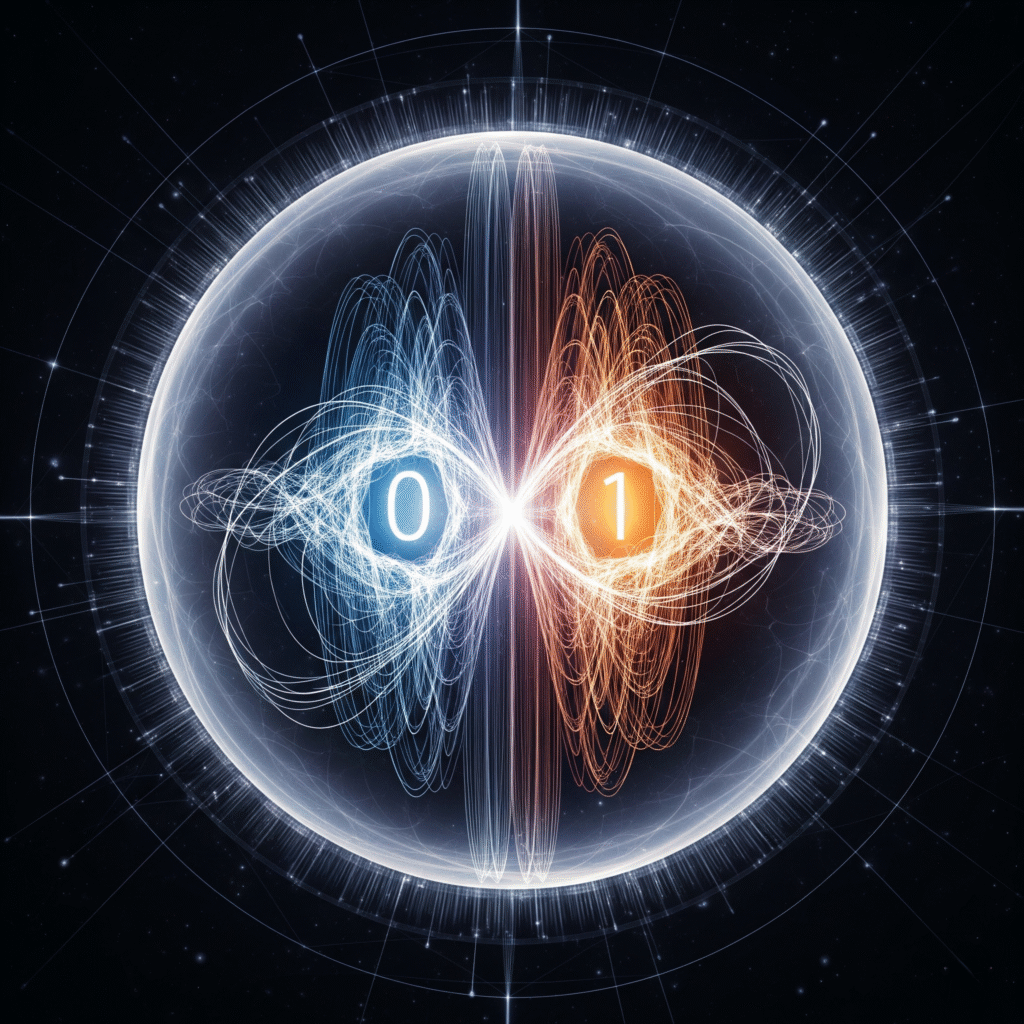
A qubit, however, operates on a different set of rules. Thanks to a quantum principle known as superposition, a qubit can be a 0, a 1, or both simultaneously. Imagine a spinning coin. While it’s in the air, it’s neither heads nor tails; it’s in a state that encompasses both possibilities. Only when it lands (or is measured) does it collapse into a definite state of either heads or tails. A qubit exists in a similar state of probabilistic potential until it is measured.
This ability to exist in multiple states at once allows quantum computers to process a vast amount of information simultaneously. While two classical bits can represent one of four possible combinations (00, 01, 10, 11) at any given time, two qubits in superposition can represent all four combinations at the exact same moment. This power grows exponentially. With just 300 qubits, a quantum computer could represent more states than there are atoms in the known universe.
Entanglement: Einstein’s “Spooky Action at a Distance”
If superposition wasn’t mind-bending enough, qubits have another trick up their sleeve: entanglement. This is a quantum phenomenon where two or more qubits become linked in such a way that their fates are intertwined, no matter how far apart they are.
If you measure the state of one entangled qubit, you instantly know the state of its partner, even if it’s on the other side of the galaxy. Albert Einstein famously called this “spooky action at a distance.” For quantum computing, this interconnectedness is a feature, not a bug. It allows for incredibly complex and correlated calculations, creating powerful computational shortcuts that are impossible for classical computers to replicate. By linking qubits together, quantum algorithms can solve complex problems where many variables are interdependent.
The Power to Solve the Unsolvable
The unique properties of qubits mean quantum computers aren’t designed to replace your laptop for tasks like sending emails or browsing the web. Instead, they are specialized machines built to tackle a specific class of problems known as “intractable problems”—those that are computationally too complex for even the most powerful classical supercomputers to solve in a reasonable timeframe.
These problems often involve a massive number of variables and potential outcomes, such as simulating molecular interactions, factoring large numbers, or optimizing complex systems. This is where the exponential power of quantum computing shines, opening doors to breakthroughs we could once only dream of.
Implication 1: Shattering Modern Cryptography
Perhaps the most talked-about—and feared—implication of quantum computing is its potential to break modern cryptography. Most of the encryption that protects our sensitive data online, from bank transactions to government communications, relies on the difficulty of factoring large prime numbers. A classical computer would take trillions of years to crack a standard RSA encryption key.
A sufficiently powerful quantum computer, however, running an algorithm like Shor’s algorithm Shor’s algorithm, could theoretically do it in a matter of hours or days. This poses an existential threat to our current digital security infrastructure.

But the quantum world offers a solution as well: Quantum Cryptography. Technologies like Quantum Key Distribution (QKD) use the principles of quantum mechanics to create unhackable communication channels. In a QKD system, any attempt by an eavesdropper to observe the quantum key would disturb its state, immediately alerting the sender and receiver. This ushers in a new era of “quantum-safe” encryption, a critical field of research as we prepare for a post-quantum world MIT Technology Review.
Implication 2: Revolutionizing Drug Discovery and Materials Science
The development of new drugs and materials is an incredibly complex and expensive process. It involves simulating how molecules will interact, a task that is often too complicated for classical computers because molecules are inherently quantum systems. A classical computer can only approximate these interactions.
A quantum computer, on the other hand, can simulate molecular behavior with perfect accuracy because it operates on the same quantum principles. This could revolutionize the pharmaceutical industry and materials science in several ways:
- Accelerated Drug Development: Scientists could design and test new drug candidates in a virtual environment, simulating how they will bind to proteins and viruses. This could drastically reduce the time and cost of bringing new life-saving medicines to market, from cancer treatments to novel antibiotics.
- Designing Novel Materials: Quantum simulations could allow us to design new materials atom by atom. Imagine creating superconductors that work at room temperature, more efficient catalysts for clean energy production, or stronger and lighter materials for aerospace and construction.
- Personalized Medicine: By simulating an individual’s unique genetic makeup and its interaction with various compounds, quantum computers could pave the way for truly personalized medicine, designing drugs tailored specifically for a patient’s body.
Implication 3: Transforming Financial Modeling and Optimization
The financial world is a massive, interconnected system of variables, risks, and potential outcomes. Quantum computers are perfectly suited to tackle the complex optimization and simulation problems at the heart of modern finance.
- Risk Analysis and Portfolio Optimization: Financial institutions constantly run complex simulations, like the Monte Carlo simulation, to model market risks and optimize investment portfolios. Quantum computers could run these simulations with far greater speed and accuracy, analyzing a larger set of variables and identifying investment strategies that are invisible to classical models.
- Algorithmic Trading: Quantum algorithms could identify complex patterns and correlations in financial markets that are currently undetectable, leading to more sophisticated and faster high-frequency trading strategies.
- Derivative Pricing: The pricing of complex financial derivatives is a computationally intensive task. Quantum computers could provide more accurate and real-time pricing, reducing risk and improving market efficiency.
The Challenges Ahead: We’re Not There Yet
While the promise of quantum computing is immense, the road ahead is filled with significant engineering challenges. Qubits are incredibly fragile and sensitive to their environment. Even the slightest vibration or temperature fluctuation can cause them to lose their quantum state in a process called decoherence.
Building and scaling fault-tolerant quantum computers that can overcome these errors is the primary focus of researchers at companies like Google, IBM, and Microsoft, as well as numerous startups and universities around the world. We are currently in what is known as the Noisy Intermediate-Scale Quantum (NISQ) era. Today’s quantum computers have dozens to hundreds of qubits, but they are “noisy” and prone to errors, limiting the complexity of the problems they can solve Noisy Intermediate-Scale Quantum (NISQ).
However, progress is accelerating. Each year brings new breakthroughs in qubit stability, error correction, and the number of entangled qubits. The question is no longer if we will have large-scale, fault-tolerant quantum computers, but when.
Embracing the Quantum Future
Quantum computing is more than just an incremental improvement in processing power; it is a fundamental shift in how we approach computation. By tapping into the laws of the quantum world, we are building machines that can understand the universe in its native language.
From creating unbreakable codes and designing miraculous new drugs to optimizing global financial markets and creating novel materials, the potential applications are boundless. The journey from today’s noisy, experimental devices to full-scale quantum computers will be challenging, but the dawn is here. We are standing at the threshold of a new technological revolution, one that promises to solve the unsolvable and reshape our world in ways we are only just beginning to imagine.
