 acadewise
The debate of 5G vs 6G is heating up 5G networks as 5G networks roll out worldwide while research on 6G is rapidly advancing. As of early 2024, over 343 operators in 126 countries have launched or soft-launched 5G networks (digitalregulation.org). Meanwhile, 6G – officially called IMT-2030 – is in early research and standardization phases, with a target launch around 2030 (digitalregulation.org, ainvest.com). 5G vs 6G is not just about faster speeds, but about the transformation of industries, connectivity, and global digital infrastructure.
A 5G wireless telecommunications tower with multiple antennas for advanced mobile broadband connectivity. Modern 5G networks (based on IMT-2020 standards) support enhanced mobile broadband (eMBB), massive machine-type communications (mMTC) and ultra-reliable low-latency communication (URLLC). They operate in low (<6 GHz) and high (mmWave, ~24–40 GHz) bands, delivering peak speeds up to ~20 Gbps in ideal conditions livescience.com. While actual 5G speeds seen by users today are often in the hundreds of Mbps, 6G aims to be orders of magnitude faster. Researchers have already demonstrated wireless transmissions near 0.94 Tbps (938 Gbps) in lab conditions livescience.com. In practice, 6G is expected to utilize even higher “terahertz” frequencies (90–300 GHz) to tap into vast spectrum for ultra-high data rates livescience.com.
Figure 1: 5G vs 6G concept image showing a cell-tower silhouette and a globe — comparison of global 5G and 6G network impact
5G vs 6G: Key Differences You Must Know
5G and 6G build on the same foundation of cellular communications, but differ significantly in capability:
- Peak Data Speed: 5G can reach tens of gigabits per second under ideal conditions; 6G is targeting up to 1 terabit per second livescience.com – roughly 10× to 100× faster.
- Latency: 5G networks are designed for ~1 ms latency; 6G aims for sub-millisecond (on the order of 0.1 ms or even microsecond) latencies for truly real-time interactions.
- Frequency Bands: 5G uses sub-6 GHz (for coverage) and mmWave (~24–40 GHz) bands. 6G will extend into terahertz bands (>90 GHz), requiring new RF hardware and propagation solutions ericsson.com.
- AI and Sensing: 6G is expected to be AI-native, with machine learning built into the network for tasks like network optimization and predictive maintenance digitalregulation.org. It will also integrate sensing – e.g. environmental monitoring and high-precision positioning – into communication links.
- Use Cases: 5G enabled ultra-HD streaming, autonomous vehicles (level 3), factory automation, and smart cities. 6G will add new use cases: fully immersive AR/VR and holographic telepresence, remote surgery and medical devices, digital twins of real-world systems, and anywhere coverage including air and space platforms digital-strategy.ec.europa.eudigitalregulation.org.
- Architecture: 6G will further leverage software-based, cloud-native network design (from 5G) and network slicing, but on a larger scale. It may natively support non-terrestrial networks (drones, satellites) alongside terrestrial cells.
- Energy and Efficiency: 6G research emphasizes energy efficiency and sustainability. Power-per-bit goals will be critical as 6G hardware (especially at THz frequencies) will consume more power per link.
A summarized comparison table highlights these points:
| Feature | 5G (IMT-2020) | 6G (IMT-2030, target) |
| Peak Speed | Up to ~20 Gbps (5G mmWave lab demo) livescience.com | Up to ~1 Tbps (1000 Gbps) (future lab targets) livescience.com |
| Latency | ~1 ms (end-to-end) | <0.1 ms (aiming for ~100 μs or lower) |
| Frequency | Sub-6 GHz, mmWave (24–40 GHz) | mmWave plus terahertz (90–300+ GH) ericsson.com |
| Coverage | Primarily terrestrial (cell towers, small cells) | Terrestrial + integrated satellite/non-terrestrial |
| Use Cases | eMBB (ultra-HD video), IoT sensors, URLLC (industry) | Immersive XR (AR/VR/hologram), digital twins, remote surgery, AI-driven IoT digital-strategy.ec.europa.eudigitalregulation.org |
| Key Tech | Massive MIMO, beamforming, network slicing, edge cloud | Advanced MIMO/RIS, photonics, AI-edge fusion, quantum-safe security |
| Timeline | Commercial global rollout (2020s) digitalregulation.org | Research until 2028, specs and trials late 2020s, launch ~2030 ainvest.comericsson.com |
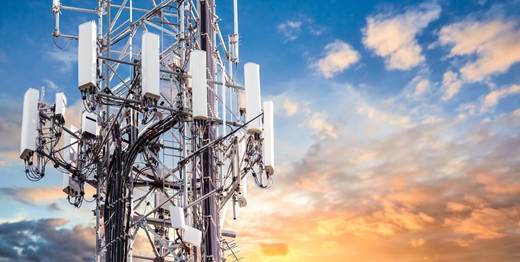
Figure 2: 5G cell tower with multiple antennas at sunset — mobile network infrastructure for high-speed 5G wireless coverage
5G vs 6G Timeline: Global Development Roadmap 2020–2030
The 5G vs 6G roadmap shows that while 5G commercialization started in 2020, 6G will enter trials around 2028 and commercial launch by 2030. ITU and 3GPP are driving standardization, while countries like the U.S., EU, China, and India are shaping research agendas.
The development of 6G is coordinated internationally under the banner of IMT-2030. Key milestones and events include:
- 2020–2022: ITU prepares for 6G vision. In 2022, ITU-R released a “framework” report (M.2160) outlining IMT-2030 scope. Early research concepts (like “Internet of Senses”) emerge digitalregulation.org.
- 2023: Major research initiatives start. The EU’s Smart Networks & Services Joint Undertaking (SNS JU) was launched (EU budget €900M) to drive 5G/6G R&D through 2027 digital-strategy.ec.europa.eu. The Bharat 6G Vision in India is published (Mar 2023). 3GPP begins early 6G study items (Release 19 in 2024) ericsson.com.
- 2024–2026: ITU-R defines requirements. From 2024–2026, ITU works on technical performance requirements for IMT-2030 ericsson.com. Several countries commit to 6G funding and strategy (e.g. China’s IMT-2030 Promotion Group, Korea’s 6G consortium). By late 2024, ITU invites proposals for candidate 6G radio technologies (to be submitted by mid-2027) digitalregulation.org.
- 2025: Formal global 6G research kicks off. For example, China’s Ministry of Industry and Information Technology announced start of 6G technical standards work by June 2025 ainvest.com. 3GPP marks the beginning of Release 19 with high-level requirements for 6G (approved Sept 2024, finalizing mid-2026) ericsson.com.
- 2027–2029: Standardization phase. 6G candidate technologies are submitted to ITU in late 2027–2028. 3GPP plans to finalize 6G specifications (Release 21) by end of 2028 ericsson.com. By 2029, ITU will have evaluation results.
- 2030: Commercial launch. ITU is expected to officially designate 6G (IMT-2030) by 2030 ericsson.com. Early trials and first deployments could begin around 2030, similar to how 5G began around 2019–2020. Full global rollout (infrastructure, devices, spectrum auctions) would then progress through the early 2030s.
Overall, the 6G roadmap is roughly:
- 2024–26: Requirements definition (ITU, 3GPP).
- 2027–28: Technology proposals and early specs.
- ~2029: Standard approval, with first networks by 2030.
- Around 2030 onward: 6G commercial networks come online worldwide ericsson.comericsson.com.
Figure 3: Futuristic smart city concept powered by 6G — holographic displays, connected infrastructure and ultra-fast wireless networks
5G vs 6G Readiness: US, EU, China, and India Compared
Different regions are advancing toward 6G at varying paces:
- United States: Industry-led groups like the ATIS Next G Alliance (NGA) outline a 2030 timeframe for 6G commercialization. NGA expects 6G to build incrementally on 5G (especially 5G-Advanced), enhancing capacity and using new mid-band spectrum (7–15 GHz) nextgalliance.org. The FCC’s Technological Advisory Council and Congress are evaluating spectrum policy to reserve higher bands for 6G and supporting research (though carriers are currently focused on expanding 5G). The U.S. also signed a joint statement (with allies) endorsing 6G principles of security and open innovation digitalregulation.org.
- European Union: The EU is mobilizing public-private partnerships. The SNS JU (€900M fund) drives R&D and aims to “implement 6G research leading to conception and standardization around 2025,” with early products by end of decade digital-strategy.ec.europa.eu. In mid-2025, EU leaders expected 6G trials and pilot projects (European Commissioner Breton indicated 6G in deployment by ~2030 digital-strategy.ec.europa.eu). The EU’s 6G Industry Association (6G-IA) coordinates with like-minded countries (via Trade & Tech Council) to set global standards.
- China: Very proactive on 6G. China’s government-backed IMT-2030 Promotion Group launched in 2022 and plans formal 6G research from mid-2025. It targets its first 6G technical spec by March 2029 and commercial launch around 2030 ainvest.com. Chinese companies (Huawei, ZTE) and institutions are heavily invested in 6G R&D. An analysis notes China’s roadmap is two-phased: research (2018–2025) and standardization/commercialization (2026–2030) ainvest.com. Challenges cited for China include optimizing terahertz bands and reducing energy use ainvest.com.
- India: The government released a Bharat 6G Vision (Mar 2023) aiming for global leadership by 2030 pib.gov.in. Initiatives include creating 100 5G test labs across academic institutes, funding research (¥275 crore TTDF scheme for 6G projects), and forming industry consortia (Bharat 6G Alliance) pib.gov.in. India’s push is to build on its rapid 5G rollout, with an eye toward manufacturing and “Atmanirbhar” (self-reliant) technologies. By 2030, India envisions 6G enabling ultra-fast broadband, integrated sensing, ubiquitous coverage (including rural), and AI-native networks pib.gov.in.
| Region | Status & Initiatives |
| US | Next G Alliance outlining 6G by 2030, focus on mid-band 7–15 GHz nextgalliance.org; FCC evaluating high-band spectrum. Industry and DOD research funding. |
| EU | SNS JU (€900M) funds 6G R&D (2021–27); standards work from ~2025 digital-strategy.ec.europa.eu. EU-ROK-Japan collaboration and global principles agreement. Trial infrastructure by late 2020s. |
| China | IMT-2030 Promotion Group formal R&D from 2025; first specs by 2029, deploy by 2030 ainvest.com. Major corporate and state-led labs. |
| India | Bharat 6G Vision 2023; 100+ 5G labs, ₹275Cr funding, industry alliance pib.gov.in. Aiming to leverage 5G momentum for 6G leadership by 2030 pib.gov.in. |
Each region emphasizes different priorities (e.g. U.S. focuses on innovation and defence uses, EU on standards and industry leadership, China on domestic tech leadership, India on connectivity and self-reliance), but all share a 2030 milestone.
5G vs 6G Use Cases: Real-World Applications and Future Potential
6G’s ultra-high speed and intelligence enable novel applications beyond 5G’s scope. Potential use cases often cited include:
- Extended Reality (XR): Truly immersive AR/VR/holographic communications for gaming, education, and collaboration. For example, telepresence meetings with lifelike 3D avatars or interactive augmented reality overlaid on the physical world. The EU 6G roadmap explicitly lists “virtual and augmented reality, hologram devices” as expected 6G use cases digital-strategy.ec.europa.eu.
- Digital Twins: Real-time, high-fidelity digital replicas of cities, factories, or complex systems, enabled by ultra-low latency and sensing. These twins allow simulation and control (e.g. smart grid management, urban planning) with 6G linking physical sensors to cloud models.
- Remote Healthcare: Advanced telemedicine and remote surgery over the air. 6G’s reliability and low latency (potentially 100× better than 5G) could allow surgeons to operate robotic instruments from afar or to transmit high-resolution medical imaging instantaneously. “Remote surgery” is explicitly noted among 6G scenarios digital-strategy.ec.europa.eu.
- Autonomous Transportation: While 5G supports some vehicle automation, 6G can enable fully autonomous fleets (cars, drones, ships) with redundant connectivity (5G+ satellite) and cooperative sensing. Vehicles could share real-time sensor data (LiDAR/HD maps) at Tbps speeds for coordinated traffic flow.
- Internet of Everything: Billions of devices (IoT sensors, wearables) with 6G’s enhanced coverage and density support. 6G could integrate not just objects but also humans and AI agents into the network seamlessly. For example, body-area networks, neural interfaces, and brain–computer links might emerge.
- Edge AI and Real-Time Analytics: With AI built into the network, use cases like smart factories with instant anomaly detection, or real-time language translation in meetings, become viable. 6G can distribute AI tasks across a wide network with microsecond latency.
- Integrated Space–Air–Ground Networks: 6G envisions native support for non-terrestrial networks (NTN). Use cases include global satellite internet (6G* Internet), connected UAV swarms, and maritime IoT, all managed under a unified 6G architecture. This enables connectivity everywhere – cities, highways, oceans, and even airborne platforms.
These use cases rely on 6G’s new and enhanced capabilities. The ITU IMT-2030 framework identifies nine enhanced 5G capabilities (e.g. peak data rate, connection density, positioning accuracy) and six entirely new ones for 6G digitalregulation.orgdigitalregulation.org. For instance, 6G expects much higher connection density (enabling e.g. millions of sensors per km²) and integrated sensing/communication for precise environment awareness. The above examples illustrate how 6G could transform industries from entertainment to transportation and healthcare.

Figure 4: Digital globe showing global connectivity of mobile networks(https://www.dreamstime.com/)
5G vs 6G Challenges: Technical Hurdles on the Road to 2030
The 5G vs 6G transition is not without challenges:
- Terahertz spectrum propagation issues.
- Energy efficiency and power-per-bit optimization.
- Complex integration of satellites, AI, and dense small cells.
- Standardization and interoperability across regions.
Realizing 6G’s potential involves overcoming major technical hurdles:
- Spectrum and Propagation: 6G will rely on frequencies up to the terahertz range (90–300 GHz and beyond) to achieve ultra-high data rates livescience.com. Propagation at these frequencies suffers high path loss and limited range. Challenges include developing new channel models, solving blockage issues (THz waves are absorbed by atmosphere and obstacles), and coordinating spectrum globally. Innovations like reconfigurable intelligent surfaces (RIS) and advanced beamforming will be needed to extend coverage. ITU and regulators must harmonize these new bands (e.g. WRC-27 will study 7.125–8.4 GHz and 14.8–15.35 GHz for 6G) digitalregulation.org.
- Terahertz Hardware: Radios and antennas for THz frequencies are in early stages. New semiconductor materials (graphene, photonic chips) and amplifier designs are needed. Recent lab demos (e.g. combining photonics and mmWave electronics livescience.com) show promise but must be scaled to practical devices. Terahertz signal generation, low-noise amplification, and wideband ADC/DACs are active research areas.
- Power & Energy: Operating at very high frequencies with huge bandwidth can consume significant power. 6G must improve energy efficiency dramatically. Research is focusing on ultra-low-power transceivers, energy-harvesting (solar, RF harvesting), and AI-driven power management. Otherwise, deploying dense 6G cells everywhere would be unsustainable.
- Network Complexity: 6G networks will be massively more complex – dense small cells, satellite integration, network slicing for many verticals, and on-device AI. Orchestrating such a heterogeneous system raises challenges in software design, interoperability, and security. Software-defined networking (SDN) and AI management can help, but also introduce potential vulnerabilities (so security by design is critical).
- Standardization & Collaboration: Aligning on global standards is non-trivial. As noted, China, US, EU and others may have differing priorities or IP positions. The ITU designation process (IMT-2030) must reconcile proposals and ensure interoperability. Regulatory issues (e.g. spectrum licensing, coexistence with incumbent users) also pose hurdles.
- Hardware Integration: 6G devices (smartphones, IoT modules) will need new chipsets supporting terahertz front-ends and advanced processing (AI co-processors). Integrating these into power-limited mobile devices is a challenge. Packaging, thermal management, and cost will factor heavily.
In short, the road to 6G requires breakthroughs in radio physics, materials science, and computing. For example, China’s analysis warns that “optimizing terahertz bands and reducing energy consumption” are key hurdles ainvest.com. The EU and US stress open, secure design and spectrum sharing. Overcoming these challenges will take coordinated R&D and time.
Illustration of global digital connectivity, symbolizing the worldwide reach of next-generation mobile networks.
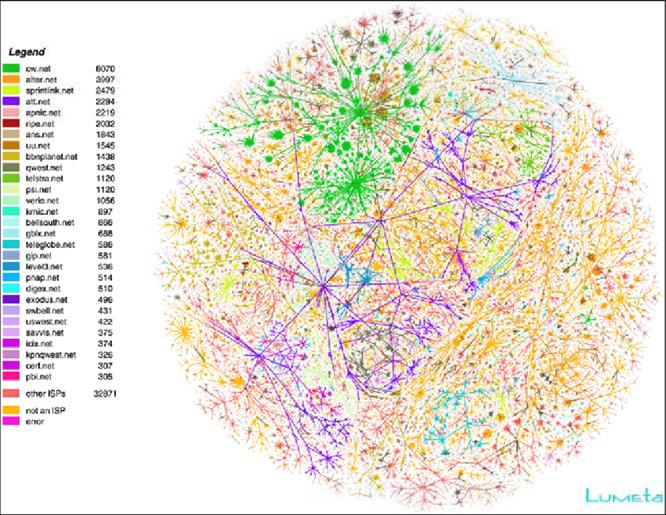
Figure 5: A graph visualisation of the topology of network connections of the core of the Internet. (Source: Bill Cheswick, http:// www.lumeta.com)
5G vs 6G Preparation: Business & Telco Strategy Checklist
Telcos and enterprises must prepare for the 5G vs 6G evolution:
- Monitor IMT-2030 standards.
- Invest in R&D and trials.
- Plan spectrum strategy (6–15 GHz and THz bands).
- Upgrade to cloud-native, AI-driven networks.
- Build partnerships across industries.
- Focus on sustainability and energy efficiency.
Those who act now will lead in the 5G vs 6G era by 2030.
Summary Checklist: Preparing for 6G (Telcos & Businesses)
Businesses and service providers should start preparing now for the 6G era. Key action items include:
- Monitor Standards & Research: Stay informed on IMT-2030 standards (ITU-R, 3GPP releases) and frequency allocation developments. Participate in industry consortia (e.g. 6G-IA, Next G Alliance).
- Invest in R&D and Trials: Build labs or partner on 6G testbeds for prospective use cases (e.g. AR/VR demos, network slicing trials). Field trials (even for 5G-Advanced) will inform 6G strategies.
- Spectrum Strategy: Secure access to mid/high bands (e.g. 6–15 GHz) as soon as regulators allow. Plan for future terahertz spectrum (WRC-27 implications).
- Network Architecture Evolution: Upgrade current networks to cloud-native, software-based platforms. Embrace virtualization, distributed edge computing and AI automation now, as these will be central to 6G operations.
- Build Partnerships: Forge alliances across industries (e.g. automotive, health, manufacturing) to develop 6G vertical applications. Collaboration with satellite and aerospace players will also become important.
- Focus on Sustainability: Develop energy-efficient hardware and green operation practices to ensure 6G networks are sustainable. 6G is expected to emphasize energy per bit improvements.
- Talent and Training: Upskill teams in key 6G technologies – terahertz RF engineering, AI for networks, advanced software/AI security, etc. Recruit researchers and engineers in these cutting-edge areas.
- Business Model Planning: Envision new services enabled by 6G (holographic communication, AI-as-a-service, etc.) and how they could be monetized. The 6G era will likely see new players and partnerships.
In summary, the global 5G vs 6G roadmap shows a clear path: 5G continues expanding this decade, while 6G will reshape industries by 2030 with unprecedented speed, intelligence, and connectivity. Businesses and telcos that prepare early will be best positioned to thrive in the coming 5G vs 6G revolution.
